
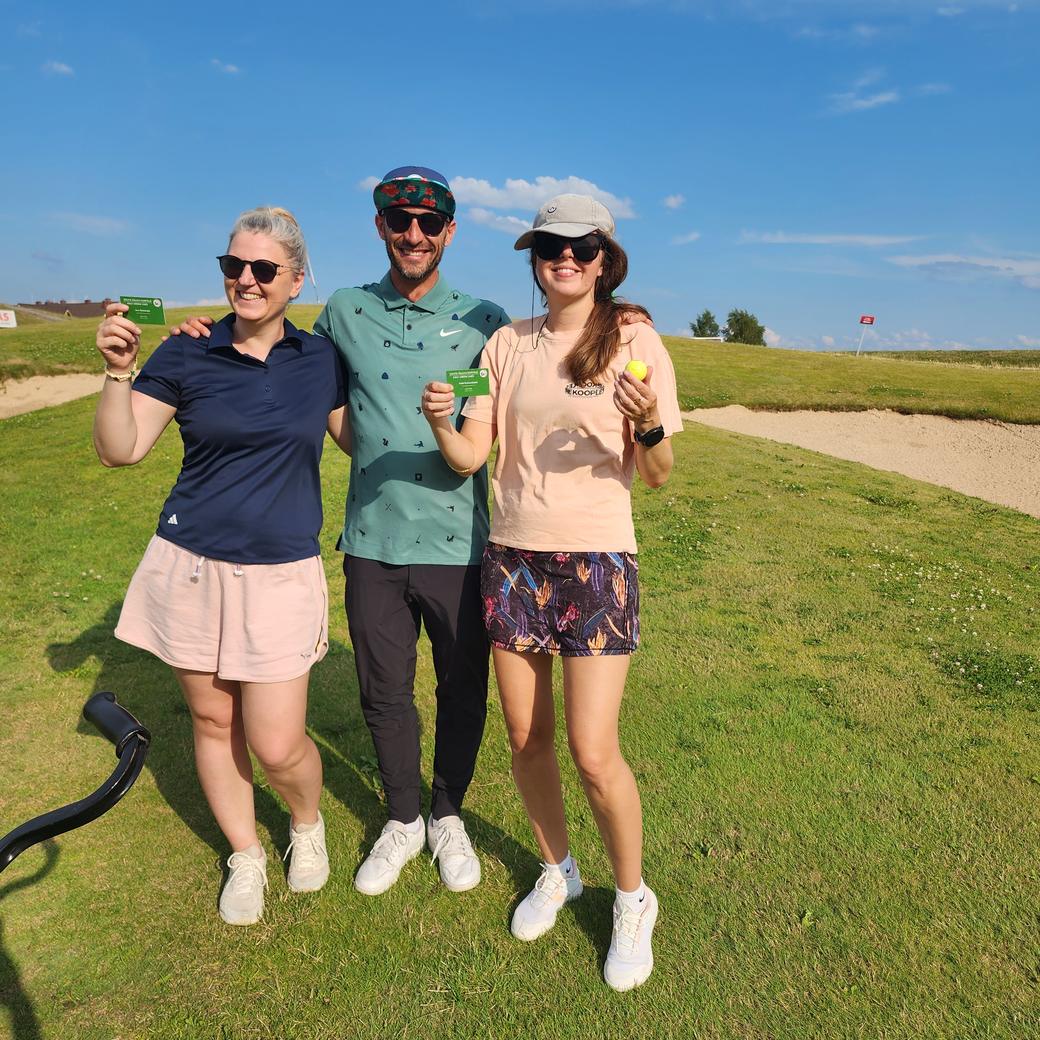
If you have started looking into golf, you have probably run into the phrase “green card” and wondered whether you need one, what it involves, and how to get it. Short version: in much of Europe, the green card is the beginner’s certificate that says you are safe and ready to play a real course. Here is the honest, practical version of what it is and how you get one.
What a golf green card actually is
The green card (Platzreife in German-speaking countries, žalioji kortelė in Lithuania) is best thought of as a driving licence for the golf course. It is proof that you know the rules, understand the etiquette, and can play at a safe, reasonable pace without holding anyone up or putting anyone in danger.
It is not a skill ranking. Nobody is measuring whether you can break 90. It certifies competence and courtesy, the two things a course actually cares about before letting a stranger loose on it.
Why it exists, and why some countries skip it
Golf is one of the few sports where complete beginners share the same space as experienced players, often with hard balls travelling a long way. The green card is how clubs make sure a newcomer knows where to stand, when to let a faster group through, how to repair the course, and how not to hit anybody.
That is why the concept is strongest in continental Europe, in Germany, Austria, Switzerland, the Nordics, and the Baltics, where many courses will ask to see a green card or a handicap certificate before they let you play. In the UK, Ireland, and the US the idea barely exists. Those courses tend to be pay-and-play and rarely ask for proof of anything. So whether you actually need a green card depends entirely on where you plan to play.
What the green card test covers
Most green card courses combine three things:
- Theory. The basic rules and, above all, the etiquette. (Germany’s DGV test, for example, is 30 multiple-choice questions, and you pass by making only a handful of mistakes.)
- Practical. Enough of a repeating swing to move the ball safely, plus putting and the short game.
- On-course behaviour. Pace of play, safety, where to stand, and how to look after the course.
The bar is deliberately reachable. This is a beginner’s certificate, not an exam designed to catch you out.
How long it takes
A typical green card course runs over two to five days. Some providers compress it into a single long weekend; others spread it across a few evenings over a couple of weeks. You do not need any prior experience. Most people who take one have never held a club before day one.
Green card vs handicap: the difference
People mix these two up. The green card comes first: it is what gets you onto the course. A handicap comes later, once you are playing and submitting scores, and it is the number that lets you compete fairly against players of different levels. Think of the green card as the entry ticket and the handicap as the scorekeeping that starts once you are inside. In some systems, the green card is the step that lets you join a club and begin building that handicap.
How widely is it recognised?
Honestly: widely across Europe, but it is not a single global licence. A green card issued by a club affiliated with a national golf federation is generally accepted at other European courses that ask for proof of ability. It is not a formal worldwide credential, and in the UK or US you will rarely be asked for it at all. Anyone promising a “globally valid” card is overselling a piece of paper. What it genuinely buys you is the confidence, and the credential, to walk onto a course in the places that ask.
Where to get your green card
There are two honest routes:
- At home. The cheapest option is a group course at a local club, often somewhere between 150 and 400 euros depending on the country and how many hours are included. Efficient and functional, and you will usually be learning alongside a dozen strangers.
- As a trip. The other option is to treat it as an experience: go somewhere quiet, learn one-to-one or in a small group, and make a few days of it. It costs more, because you are paying for the coaching time and the trip, not only the certificate.
That second route is what we run in Lithuania: a three-day green card course with our coach Donatas, on uncrowded courses, from 500 euros per person. It suits people who would rather learn properly and privately than rush a certificate at a busy range, and groups or companies who want to learn together. If that is more your speed, here is how the course works.
Either way, the green card is a small, achievable first step. It is the thing standing between “I have always meant to try golf” and actually being out on a course.